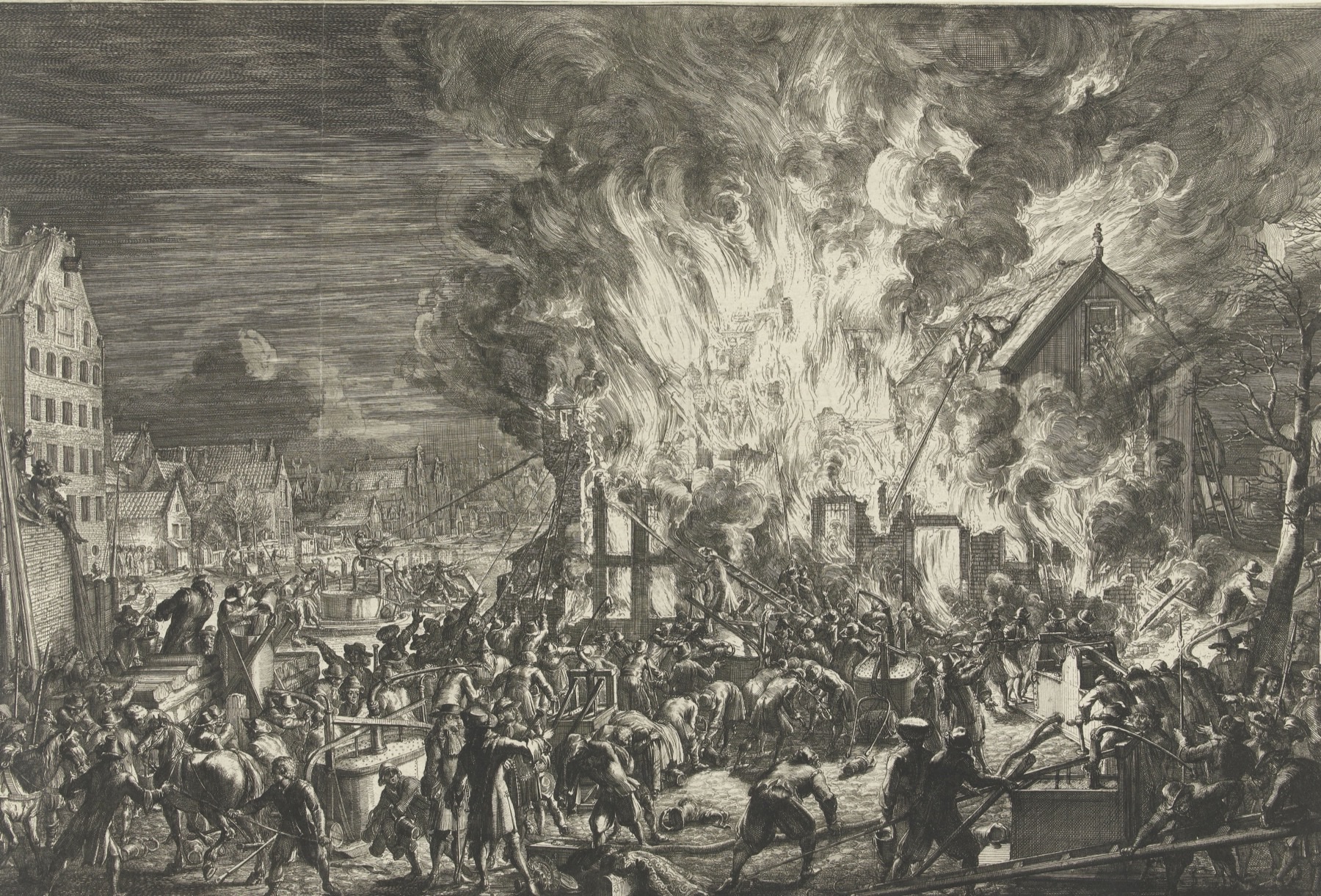
In 1666, the Great Fire of London burned 85% of the walled city and left as many as 100,000 people homeless.1Figures from the London Museum and the Oxford Faculty of History. At the time, this was a normal part of urban life. Cities across the world faced the same fate again and again: Tokyo, Chicago, Seattle, just to name a few. In Tokyo, fires were so common that a proverb called them the flowers of the city. Urban living meant urban fires, and there was very little you could do about that.
Fire fighting was done by bucket brigades. These were volunteers who would run to a fire with buckets of water and a hand pump. One pump took thirty to forty men working the handles in shifts, and they were exhausted within the hour. It was grueling work, but it was the best we had. This continued to be the state of affairs for about 200 years.
The steam-powered fire engine was invented in London in 1829. It threw two tons of water a minute and it didn't get tired.2John Braithwaite and John Ericsson built the first steam fire engine in London in 1829; it threw about two tons of water a minute. Linda Hall Library. Cincinnati's 1853 engine and paid department: Cincinnati Fire Department history. Interestingly enough, for the next twenty-five years, almost nobody used it. Fire brigades were organized around the hand pump. Just adding a steam engine didn't change how fires were fought.
Cincinnati did something different. In 1853 it put a steam engine into service, and in the same year it replaced its volunteers with the first paid fire department in the country, built around the engine. One engine threw six streams of water at once. The work that used to take about 150 men could now be done with a crew of twelve.3William M. Shields, Urban Conflagrations in the United States, and Annelise Anderson, The Development of Municipal Fire Departments in the United States (1979). The cost of fighting fires had collapsed, and this meant that for the first time, a city could afford to pay professionals to fight every fire. Other cities quickly followed. Cities stopped burning when they rebuilt their fire fighting efforts from the ground up to make use of the lower cost structure afforded by the steam engine.
Today a fire that destroys a city is rare enough that we treat it as a failure of institutions.
Today's Fire
Today in American eldercare, we have our own fire at the scale and severity of the Great Fire of London.
When Omar and I first set out to learn about the eldercare crisis, we put small signs along the side of the road that read "Eldercare Helpline" with our phone numbers on them. We knew very little about eldercare at the time, but we did our best to help everybody that called. Most calls were filled with frustration, anxiety, stress, and helplessness. A mom of three calling during her lunch break because her father fell in the shower. A wife calling to figure out how to get home care for her husband of 40 years, because they didn't want to be separated at a nursing home for the last chapter of their lives. For decades, he would come home and say "It's good to be home". They didn't want that to change now.
With every call, we kept thinking "there's no way it's actually this difficult".
It is that difficult, and the number of families going through this struggle is about to explode. Every day in this country, more than 11,000 people turn 65,4U.S. Census Bureau, Vintage 2025 population estimates. 4,155,651 residents were aged 65 on July 1, 2025, about 11,400 a day. census.gov and the 85+ population is expected to double by 2041.5U.S. Census Bureau, 2023 National Population Projections, main series. Those 85 and over go from 7.0 million in 2025 to 14.2 million in 2041. census.gov
Americans aged 85 and over, 2025–2050
Millions of people. The number doubles by 2041.
Table
| Year | Aged 85 and over, millions |
|---|---|
| 2025 | 7.0 |
| 2026 | 7.3 |
| 2027 | 7.5 |
| 2028 | 8.0 |
| 2029 | 8.3 |
| 2030 | 8.6 |
| 2031 | 8.8 |
| 2032 | 9.6 |
| 2033 | 10.2 |
| 2034 | 10.7 |
| 2035 | 11.2 |
| 2036 | 11.7 |
| 2037 | 12.2 |
| 2038 | 12.7 |
| 2039 | 13.2 |
| 2040 | 13.7 |
| 2041 | 14.2 |
| 2042 | 14.7 |
| 2043 | 15.1 |
| 2044 | 15.5 |
| 2045 | 15.9 |
| 2046 | 16.3 |
| 2047 | 16.7 |
| 2048 | 17.0 |
| 2049 | 17.2 |
| 2050 | 17.4 |
And when you look at cost, Medicare expenditures are expected to double in the coming decade, from $988 billion in 2025 to almost $2 trillion by 2036.6Congressional Budget Office, The Budget and Economic Outlook: 2026 to 2036, Table 3-2. Medicare outlays net of premiums and other offsetting receipts. cbo.gov
Medicare spending, 2025–2036
Net of premiums and other receipts. 2025 is actual, the rest is CBO's projection.
Table
| Fiscal year | Medicare outlays, $ billions |
|---|---|
| 2025 | 988 |
| 2026 | 1,063 |
| 2027 | 1,140 |
| 2028 | 1,203 |
| 2029 | 1,286 |
| 2030 | 1,356 |
| 2031 | 1,437 |
| 2032 | 1,526 |
| 2033 | 1,638 |
| 2034 | 1,751 |
| 2035 | 1,858 |
| 2036 | 1,970 |
Today in America, eldercare is complicated, frustrating, and inefficient. When a senior needs care at home, it's common for their family to spend weeks figuring out what they qualify for, and then wait in line for a caregiver to hopefully become available. We've accepted this as a normal part of getting old.
It's long been known that the solution to the eldercare crisis is to bring more of healthcare to the home. This prevents high cost hospitalizations and nursing home utilization. Two things stand in the way.
- Understanding how to get care.There's no central place a family can go to understand the care options available to their senior. This is because care is delivered by Medicaid, Medicare, the VA, Older Americans Act funding, local non-profits, managed insurance plans, etc. The few resources that do exist, like Area Agencies on Aging and Insurance Service Coordinators, are overrun with demand. Helping one family at a time takes people, and there aren't enough of them.
- Staffing the care itself.Behind every caregiver is a back office handling eligibility, authorizations, scheduling, compliance, payroll, and billing. This administrative tax consumes roughly 35 cents of every dollar that Medicaid pays for home care. In a low reimbursement state like Texas, what's left pays the caregiver around $11 an hour. This means agencies can't find caregivers at that wage, so they turn the patient away. More than two in five Medicaid personal care referrals are unable to be filled, and the top reason agencies give is that the rate doesn't cover the cost.7National Alliance for Care at Home (then NAHC), Medicaid Fill Rate Survey, August 2024. A member survey of 108 agencies in 39 states, self-reported. About 43% of Medicaid personal care referrals were rejected; 64% of agencies named low reimbursement among their top three reasons. allianceforcareathome.org By 2030 we'll need more than 1.3 million new direct care workers,8Administration for Community Living, Strengthening the Direct Care Workforce. acl.gov and we're asking them to take the job at $11 an hour.
What determines whether or not a patient gets care at home is how much of the Medicaid dollar reaches the caregiver. Right now, because of the cost of administering these programs many people are unable to receive them. The longer they wait, the more likely they are to end up in a hospital or nursing home that costs much more than the home care would've cost.
Our Fire Department
I find solace in the fact that we're living through a massive technological inflection in Agentic AI. An inflection on par with the advent of the steam engine, the laying of railroads, and the electrification of America.
In fire fighting, the steam engine took over the pumping. What was left was the skilled work. Agentic AI does the same for eldercare. It takes over the administrative work that sits between a family and their home care. What's left is the caregiver in the home, being paid a living wage.
A home care agency today is built around manual workflows the same way a fire brigade was built around the hand pump. Its margins, its office, its scheduling, and its relationship with the state all assume that a person has to touch every step. We could try to sell software to these agencies, but then you'd just get a slightly faster bucket brigade. The cost structure doesn't change, and the caregiver still makes $11 an hour.
In the last couple years, AI models have become immensely competent. Intelligence is no longer the bottleneck. The bottleneck today is rebuilding eldercare at home around an entirely new cost structure, one where the cost of administrative labor trends towards zero. So we took on the challenge of rebuilding home eldercare from the ground up. We became a healthcare provider, with the goal of helping people access and receive the care they need to live at home.
Understanding how to get care.
What started off as signs that Omar and I placed on the side of the road is now the Eldercare Helpline, an online resource that more than 10,000 people use every week to understand their eldercare options. The helpline uses agent swarms to build and maintain the most comprehensive public dataset of the eldercare network in the country. It finally offers one place to understand, navigate, and receive eldercare. Once families understand their options and best path forward, many qualify to work with our partners to get a Care Advocate who can help them follow through with the plan.
Staffing the care itself.
We built a vertically integrated home care provider where AI handles eligibility, authorizations, scheduling, billing, compliance, payroll, and the phone calls in between. The administrative work that eats a third of the Medicaid dollar at a typical agency is done by agents at ours, and the savings go back to the caregiver as a higher wage. We pay top of market while staying on top of the things a state Medicaid program cares about most: quality, compliance, and fraud prevention. Since launching in the summer of 2025, we've delivered over half a million hours of care.
By pushing in these two directions, we're allowing more seniors to discover, enroll in, and receive the home care benefits designed to help them live at home.
We can't do this alone.
At Brevy our mission is to double America's capacity to care for its elders. This means expanding Brevy to other states beyond Texas and other healthcare offerings beyond personal care.
- If you're a builder. We're a team of experienced AI engineers and healthcare operators. If you enjoy digging into multiplayer harness engineering and Section 1915(b)(4) waivers in the same day, this might be the right place for you.
- If you provide care to elders. Please reach out. We'd love to add you as a resource on the helpline. Demand still outstrips supply.
- If you run a health plan or a state program. Every member who can't get care at home ends up somewhere more expensive. We'd love to work with you to keep them home.
One defining characteristic of a large technology wave is that it's hard to imagine life before it. It's hard to imagine today the burning of an entire city.
Come help us build a future where it's hard to imagine a time when eldercare was a crisis. A future where every senior who wants, can keep saying "It's good to be home".